Clean Air Day 2026: Why Ventilation Cleaning Matters
Clean Air Day 2026 spotlights indoor air. How ventilation cleaning & fire damper testing keep buildings safe & compliant.
Clean Air Day 2026 takes place on Thursday, 18 June 2026 and is the UK's largest air pollution awareness campaign, run by the charity Global Action Plan. While much of the focus falls on outdoor pollution from traffic, indoor air quality is just as important — the air inside offices, hospitals, schools and commercial kitchens is shaped largely by ventilation systems. Over time, ductwork, extract systems, and Local Exhaust Ventilation (LEV) accumulate dust, grease, and contaminants that reduce air quality and increase fire risk. Regular ventilation cleaning keeps these systems efficient, hygienic and compliant with UK regulations such as the Regulatory Reform (Fire Safety) Order 2005 and BESATR/19 guidance. System Hygienics provides specialist ventilation cleaning, extract cleaning, and LEV cleaning, as well as fire damper testing nationwide, helping building owners and facilities managers protect occupant health and meet their legal duties.
Every June, the UK pauses to think about the air we breathe. Clean Air Day 2026, on Thursday 18 June, is the country's biggest campaign to raise awareness of air pollution and the simple steps we can all take to reduce it. Coordinated by the environmental charity Global Action Plan, the day brings together schools, hospitals, local authorities and businesses under a single message: cleaner air is possible, and it benefits everyone.
Much of the conversation centres on outdoor pollution — traffic fumes, nitrogen dioxide and particulate matter. But there is a side of the story that often gets overlooked: the air inside the buildings where we spend most of our day. For employers and facilities managers, indoor air quality is not just a wellbeing issue. It is a legal and safety responsibility, and it begins with clean, well-maintained ventilation.
Indoor air quality: the overlooked half of the problem
We tend to picture air pollution as something that happens on busy roads. In reality, air pollution is the largest environmental risk to UK public health, and we spend around 90% of our time indoors, where pollutants from cooking, cleaning products, heating and outdoor air all accumulate. In a workplace, the ventilation system is the lungs of the building— drawing in fresh air, extracting stale air, and keeping the environment healthy for staff, patients and customers.
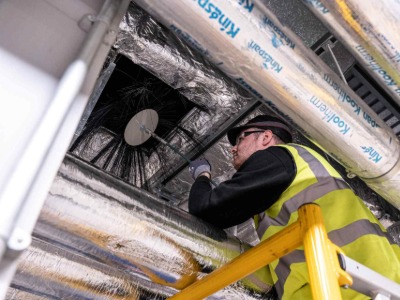
The problem is that these systems do not stay clean on their own. Dust, grease, debris and microbial growth gradually build up inside ductwork and extract systems. A neglected system circulates contaminants rather than removing them, leaving occupants breathing poorer-quality air and putting extra strain on the building's HVAC equipment. Clean Air Day is the perfect prompt to look beyond the obvious and ask a simple question: when was our ventilation last properly cleaned?
How ventilation cleaning supports cleaner air
Ventilation cleaning is the practical answer to many indoor air quality concerns. By removing the build up that collects inside ducts and ventilation units, cleaning restores airflow, improves efficiency and reduces the contaminants being recirculated around a building. The benefits are tangible: healthier indoor air, lower energy costs, longer-lasting equipment and demonstrable regulatory compliance.
In the UK, ventilation cleaning is governed by recognised standards, including BESA's TR/19 guidance and workplace health and safety legislation. Meeting these standards is not optional for commercial buildings — it is part of an employer's duty of care. This is where specialist expertise becomes essential.
System Hygienics: clean air, delivered nationwide
Established in1993, System Hygienics has built its reputation on keeping buildings compliant and their air clean. With a team of over 100 professionals operating from East Sussex and serving clients nationwide, the company delivers a complete range of air quality and hygiene services, including:
• Ventilation cleaning carried out in line with legal frameworks and workplace health and safety specifications
• Extract cleaning to keep extraction systems efficient and compliant
• LEV (Local Exhaust Ventilation) cleaning to isolate and control workplace contaminants
• Air quality assessments against British Standards and other regulations
• Fire damper testing and remedial works to maintain fire safety compliance
As proud BESA members, System Hygienics combines onsite technology and real-time IT reporting with reliable project management — providing certification, asset registers and clear documentation that give building owners genuine peace of mind. Clean Air Day is an ideal moment to review whether your ventilation systems are pulling their weight, and System Hygienics' qualified sales engineers can visit your site to assess your ongoing compliance requirements.
The fire safety connection: PTSG Fire Solutions
Clean air and fire safety are more closely linked than many people realise, and both depend on well-maintained ductwork. Ventilation systems run throughout a building, and wherever ductwork passes through a fire compartment, a fire or smoke damper is installed to stop flames and smoke from spreading in an emergency. These dampers are a critical part of any building's passive fire protection strategy.
PTSG Fire Solutions is one of the UK's leading providers in this field. As the largest division within Premier Technical Services Group, its qualified engineers deliver fire and smoke damper inspection and testing, passive fire protection, fire doors, sprinkler systems, dry and wet risers, and fire detection. Industry guidance and the Regulatory Reform (Fire Safety) Order 2005 require fire dampers to be tested on installation and at least once a year, ensuring they will close and hold backfire and smoke if the worst happens.
Together, ventilation cleaning and fire damper testing form two halves of the same picture: healthy, clean airflow on one side, and a dependable fire barrier on the other. Addressing both keeps a building safe to breathe in and safe to occupy — exactly the kind of joined-up thinking Clean Air Day is designed to encourage.
Make Clean Air Day 2026 the start of cleaner air.
Clean Air Day on 18 June is a one-day campaign, but the air inside your building matters every day of the year. For building owners and facilities managers, the most meaningful action is not a single gesture — it is committing to a programme of regular ventilation cleaning, extract cleaning and fire damper testing that keeps occupants healthy and your building compliant.
This Clean Air Day, take a moment to look up at your ductwork and consider what it is circulating. To assess your ventilation cleaning and air quality needs, contact System Hygienics — your trusted partner in clean air and compliance since 1993.
.jpeg)
.jpeg)